The Research Behind... “Doomscrolling: Why You Got Sucked In — and One Move to Get Out”
Yes, the algorithm played you. You spent more time on the internet with strangers or bots than with the person next to you. There's science behind this. The good news? One real move can break this pattern.

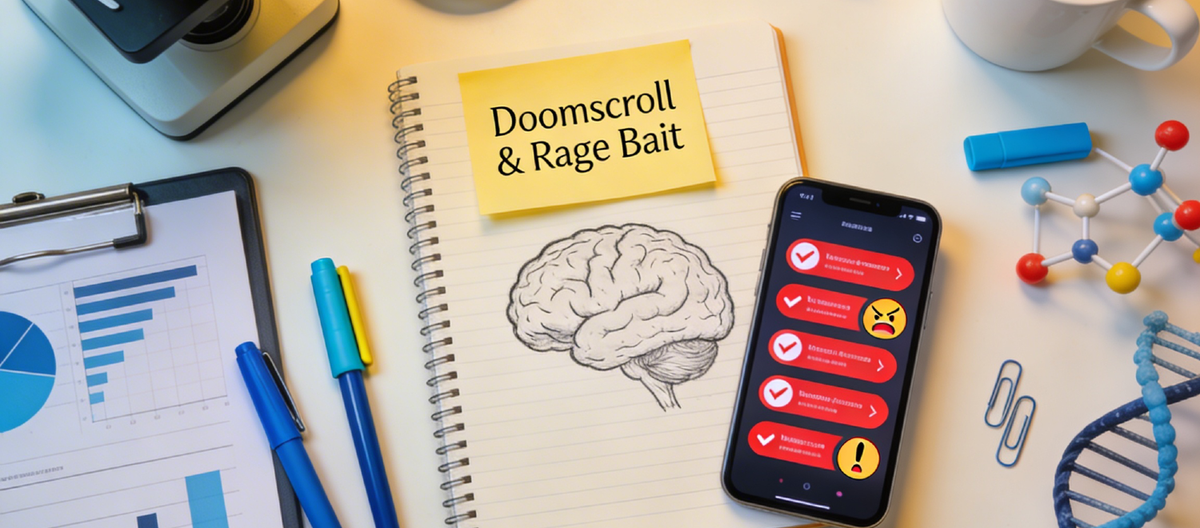
In my blog, Choosing Your Lens When the World Is Loud, I wrote about sitting on an island, watching 100 people choose to be an ohana — and then coming home, getting sick, picking up my phone, and letting the algorithm erase all of it in days.
For you, the trigger might look different. It might be politics or influencers’ kitchens, bodies, and vacations that quietly convince you what you have just isn’t up to par.
Whatever your trigger, it takes from you. It could be a great weekend that dissolves by Monday’s commute. A vacation high that evaporates the second you open your inbox. A morning that starts calm and ends furious because you checked your phone before your coffee.
Different details, same 3 AM question:
“Why can’t I stop scrolling through things that make me angry — when I know they’re making me miserable?”
That’s the Unscripted Middle — between who you were, who you are today, and who you’ll be. And it turns out, there’s actual research on why this happens. All of it makes me want to throw my phone in the ocean.
TL;DR: For Those Who Are Impatient
- Your brain stopped noticing the good stuff. That’s hedonic adaptation. Your nervous system files happiness under “normal” and moves on. The promotion, the relationship, the two weeks in paradise — your mind adjusts and calls it baseline.
- The algorithm traps you in rage clicks to drive engagement. It isn’t showing you the world. Conflict gets shares. Insta-Perfect lives do too. What you see on your feed isn’t a reflection of reality — it’s a reflection of what makes the machine money. You’re being fed a diet of conflict and calling it “staying informed.”
- You can’t stop scrolling because your brain thinks it’s protecting you. The amygdala — your threat-detection system — treats your phone like a 24/7 danger scanner. The loop is wiring, not weakness. Now you know what you’re actually up against.
- Action comes before motivation. Do it — don’t wait. Behavioral activation research is clear: you don’t wait to feel better before taking action. You do something — anything real, anything yours — and that’s what shifts how you feel. The opposite of scrolling isn’t optimism. It’s doing.
- Your feed is writing your life story for you. Negativity bias means you give more weight to threats than to good stuff. Stack that on top of hedonic adaptation and the outrage machine, and “hard” starts to feel like “terrible.” They’re not the same thing.
Now that you’re curious enough to keep reading — here are the details.
Your Feed Is an Outrage Machine. So Why Can't You Stop?
Ever question why your social feeds deliver such specific types of content to you?
Tulane University studied something called “rage clicks.” Negatively charged content — the kind that makes you mad — drives higher interaction. Why? Because people are more likely to react to what they disagree with.
A European Union CORDIS research project found the same thing: social media amplifies moral outrage because heated posts receive more likes and shares than ones without conflict.
Psychology Today has been asking “Why is everyone so angry?” for over a decade. Recent articles point to a mix of anxiety, overload, and constant perceived injustice.
Your brain is wired to notice the negative first — that’s negativity bias — and the APA has documented it extensively. Negative stimuli elicit a stronger response than positive ones. You literally give more processing power to threats, insults, and bad news than to compliments, safety, and good days.
And you already know this.
So why do you keep tapping and falling into that rabbit hole?
The Rabbit Hole Has a Name. And It’s Not “Staying Informed.”
A 2023 study published in Applied Research in Quality of Life found that doomscrolling is linked to worse mental well-being and lower life satisfaction. Not just feeling bad — measurably worse.
Harvard Health published a piece in 2024 that broke down why it’s so difficult to just stop. The behavior is rooted in your amygdala, the part of your brain that controls fight-or-flight, which is built for scanning for danger. And your phone? It’s a 24/7 danger-scanning device. The more you click, the more it insists you need to keep going to “protect you and your family.” It’s a cycle that feeds itself.
Psychology Today cited a study by Health Communication that surveyed over 1,000 people and found that when people got absorbed in the content, they couldn’t stop thinking about it! Here’s the kicker: individuals actually consume more of it in an attempt to “reduce their anxiety.” That’s ironic!
Research from NIH/PMC found that it gets worse with rumination — when you compulsively replay dark thoughts like mistakes, regrets, and things that upset you — instead of doing something about them.
It doesn’t just create anxiety and depression — it drives them.
It’s not a side effect. It’s the engine.
That’s what happened on my couch with norovirus.
I wasn’t staying informed.
I was feeding the loop.
And the loop was eating the Maui right out of me.
You Are Not Insane or Self-Sabotaging Your Life
Psychologists have a term for why you wake up every morning — healthy, breathing, with people who love you — and somehow still feel like life is terrible. They call it hedonic adaptation.
Psychology Today describes it simply: your happiness resets to baseline after good or bad events. You get the promotion and feel amazing for a week. Then it’s just... your job. You move into the dream house. Within a month, you’re complaining about the kitchen.
The Greater Good Science Center at UC Berkeley found that we derive less enjoyment from happy experiences over time. Things that spark joy initially become routine after repeated exposure — which means your ability to appreciate what’s actually good in your life quietly erodes.
It’s like a hamster wheel — no matter how much good you accumulate, your subconscious adjusts, files it under “normal,” and starts chasing the next big thing — good or bad.
Does this sound a bit like addiction or adrenaline junkie to you, or just to me?
Why Doing Something — Anything — Breaks the Cycle
Doomscrolling is rumination with a content feed.
You’re not processing.
You’re not deciding.
You’re looping.
And the algorithm is supplying fresh material for every lap.
So what breaks this hamster wheel?
First: SEE IT and stop tapping.
That part’s on you.
Then: START DOING.
The concept is called behavioral activation — it’s the fix for getting unstuck in this cycle.
A meta-analysis published in NIH/PMC reviewed 26 clinical trials with over 1,500 people. They found that doing something — anything meaningful to interrupt the pattern — was as effective as therapy and medication in breaking it.
Action comes before motivation, not after it. You don’t wait to feel better before you do something. You do something, and that’s what shifts how you feel.
When I started writing about this, that action broke the algorithmic loop for me.
I realized the scrolling didn’t make me smarter, didn’t add to my knowledge base, and didn’t add value to my life.
It did make me angry, hostile, and moody — NO THANKS!
Getting out of the rabbit hole needs more than optimism. It takes effort to refocus on what’s REAL in your life, not what’s screaming at you from a screen.
Your Move?
The outrage machine feeds you fury. Your brain’s wiring keeps you hooked. Hedonic adaptation erased the good stuff so quietly you didn’t notice. And the feed filled that empty space with everyone else’s noise.
That’s four systems working against you — without your permission or your knowledge.
Passive consumption feeds the loop.
Active engagement — in anything real, anything yours — disrupts the cycle.
If you’re in the Unscripted Middle — this is where you choose what you see through your lens. Not by fixing the world. Not by deleting your phone. By doing one thing the algorithm can’t take credit for.
Life interrupted you for a reason.
The world is loud.
The machine is hungry.
The feed keeps pulling.
You get to choose whether you keep feeding the monster or not.
You might be one real action away from realizing that your life — the actual life you’re living today — tells a different story than the one the algorithm has been selling you.
So Make ONE Move.
Start doing and pay attention to what’s REAL.